
Forecast accuracy vs decisions: bu ne anlama geliyor
A demand planning team reports 88% forecast accuracy. The same quarter, the business runs out of its best-selling line twice. Both facts are true.
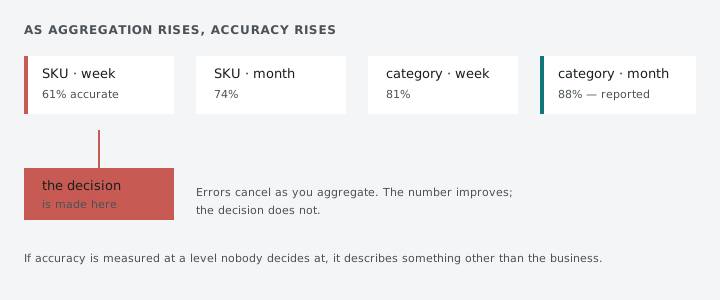
Accuracy is measured after the fact, against actuals, at whatever aggregation makes the number look stable — often monthly, often at category level. The decision that mattered was made weekly, at SKU level, for one location.
The aggregation trap
A forecast that is accurate at category-month can be useless at SKU-week. Errors cancel out as you aggregate. The number improves; the decision does not.
If your accuracy is measured at a level nobody makes decisions at, the metric is describing something other than your business.
What to measure instead
Measure the decision. For a replenishment decision, that is service level against holding cost. For pricing, margin against volume. Ask what the forecast was *for*, then measure whether that thing went better.
A slightly worse forecast that arrives in time to change an order is worth more than an excellent one that arrives after the order is placed.
Why accuracy became the metric anyway
Not because anyone believed it was the right one, but because it is the one that can be computed without agreeing on anything. Forecast versus actual is arithmetic. Service level against holding cost requires a position on what a stockout costs, and that number lives in a different function with a different incentive.
So the metric that survives the quarterly review is the one nobody has to negotiate. It is also the one that can improve for four consecutive quarters while the business gets worse at the thing the forecast exists to support.
The timing failure is separate and larger
Aggregation is the well-known version of this problem. The less-discussed one is latency, and in most operations it costs more.
A forecast produced on Tuesday for a decision made on Monday is not late by one day; it is late by a week, because the decision waits for the next cycle. The planner covers the gap with a manual adjustment, which is unrecorded, which means the next forecast cannot learn that its own timing was the problem.
Measure the interval between when the number is available and when the decision is committed. In most operations we have looked at it is longer than anyone believes, and shortening it improves outcomes more than any accuracy work would.
What a decision-level metric looks like in practice
For replenishment: fill rate at the store or line, against average inventory held. Two numbers, one ratio, and both are already reported somewhere.
For production: schedule adherence against changeover hours. If adherence rises because the plant is running longer batches of the wrong thing, the second number catches it.
For pricing: realised margin against volume, with a control group. Without the control, seasonality will take credit for the pricing work or blame for it, and neither is informative.
Each of these can be worse in a quarter where forecast accuracy improved. That is the point of measuring them.
The uncomfortable reallocation
Teams that adopt decision-level metrics usually discover that their forecasting is adequate and their decision process is not. The work that follows is unglamorous: shortening cycles, pushing the decision closer to the data, recording the manual adjustments that were always being made invisibly.
It is also where the return is. An organisation with an 82% forecast and a two-day decision cycle outperforms one with an 88% forecast and a two-week cycle, and the second organisation will spend another year improving the forecast.
One more failure mode worth naming
The forecast that is accurate, timely and still ignored. It happens when the number contradicts something the planner knows and the system cannot express — a customer who always orders late, a promotion that was pulled last week.
A forecast a person cannot argue with is a forecast they will route around silently, and the override will not be recorded. The system then learns from a history that omits precisely the cases where it was wrong.