
AI agent vs automation — An automation repeats a decision you already made. An agent makes the decision. That distinction decides which of the two you can safely deploy.
AI agent vs automation: bu ne anlama geliyor
Most of what is sold as an AI agent is an automation with a language model attached. The distinction matters, because the two fail in completely different ways.
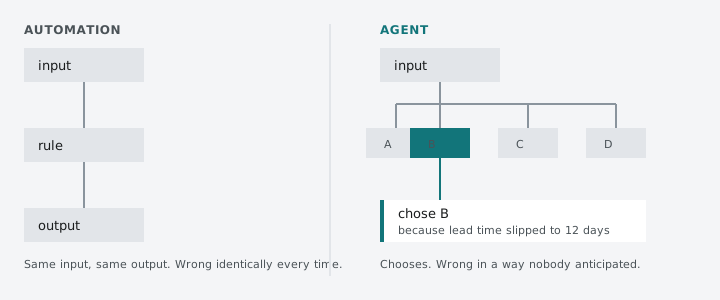
An automation executes a rule someone wrote down. If the rule is wrong, it is wrong identically every time, which makes it easy to notice and easy to fix. An agent chooses an action from a space of possibilities, using inputs that change. When it is wrong, it is wrong in a way nobody anticipated.
Why the distinction is practical, not philosophical
You can hand an automation a rule and walk away. You cannot do that with an agent, and organisations that treat the second like the first discover this at the worst moment.
What an agent needs that an automation does not: a bounded action space, a record of why it chose what it chose, and a way to reverse the action.
Where the line actually falls
“Reorder when stock drops below the reorder point” is an automation. “Decide how much to order, given a demand forecast, a supplier lead time that has been slipping, and a promotion starting in nine days” is an agent.
The second is more valuable precisely because it handles the case the rule cannot express. That is also why it needs supervision the first does not.
What the distinction costs when you get it wrong
An organisation that deploys an agent under automation governance discovers the gap at the first unusual input. The rule-based review — does the output match the specification — has nothing to check, because there is no specification. The output was a judgement.
The reverse error is quieter and more common. An automation deployed under agent governance gets a review board, a monitoring dashboard and a monthly exception meeting for a system that will produce the same output for the same input until someone changes the rule. That is not caution; it is overhead spent where nothing varies.
The questions that separate them
Three, and they can be answered before anything is built.
Does the output vary for the same input? An automation’s does not, unless its inputs changed. An agent’s can, because it is selecting from a space rather than executing a path.
Can you enumerate the possible outputs? If yes, you have a decision table and you should implement it as one. Enumerating them is also the cheapest way to discover that a problem you thought needed an agent does not.
Would a competent person disagree with the output sometimes? If no, the judgement is not real judgement and the rule should be written down. If yes, you need the record of reasoning that makes disagreement possible.
Where the language model actually sits
Attaching a language model to an automation does not make it an agent, and this is the source of most of the confusion in the market. A model that formats the output of a rule is a presentation layer. A model that reads a support ticket and routes it against a fixed list of queues is a classifier.
The agent is the thing that chooses. Whether it chooses using a model, an optimiser or a hand-written heuristic is an implementation question. The governance question is whether a choice is being made at all.
A practical consequence for procurement
Vendors describe both as agents, because the word carries a premium. The distinction is recoverable from the demonstration rather than the datasheet.
Ask to see the same input run twice with a different result, and ask why it differed. A vendor selling an automation will show you a configuration change. A vendor selling an agent will show you the record of what it compared and what tipped it. If neither is available, what is being sold is a rule with a language model in front of it — which may still be worth buying, at the price of a rule.